The real estate market in the canton of Lucerne can be most precisely explained by one key structural factor: the combination of limited building land and strictly regulated development. This starting point shapes price formation, market dynamics, and long-term stability more strongly than short-term demand impulses or economic fluctuations.
For investors, owners and institutional market participants in Switzerland, this is not a theoretical assumption, but a permanently effective market logic.
Structural scarcity as the foundation of the market
In the Canton of Lucerne, the available land for new developments is severely limited by natural conditions. Lake Lucerne and the surrounding alpine topography significantly restrict urban expansion. Furthermore, large parts of the country are regulated by landscape protection laws, zoning regulations, and infrastructure requirements.
The capital city of Lucerne therefore cannot expand freely. Growth occurs selectively, in a controlled manner, and in clearly defined development zones.
This structural situation leads to a clear imbalance: Stable demand meets a permanently limited supply.
In real estate economics, this is one of the most reliable drivers of long-term price stability. In Lucerne, this factor is not cyclical but systemically embedded.
Demand in the Swiss context
The Swiss real estate market is generally known for its stability. Lucerne, however, occupies a special position within this system, as several sources of demand overlap.
Firstly, there is constant domestic demand. In Switzerland, property is predominantly held long-term and is often part of intergenerational wealth planning. This reduces market dynamics due to high holding rates.
Secondly, the region's high quality of life acts as a stable demand factor. The proximity to the alpine landscape, combined with the high quality of life around Lake Luzerne, makes the region particularly attractive to high-income buyers who are not solely focused on profit.
Tourism as a secondary amplifier
The city of Lucerne also benefits from its strong position as a tourist destination. While this factor has less of an impact on the traditional residential property market, it enhances the attractiveness of central locations and creates a stable foundation for short-term rental concepts.
These sources of demand do not act in isolation, but rather reinforce each other within an already tight supply environment.
Price formation under scarcity conditions
In traditional real estate markets, price movements are strongly influenced by supply increases and economic cycles. In Lucerne, this mechanism is only partially effective.
The structural limitations of building land mean that price corrections are generally moderate and temporary. Even in economically uncertain times, the market is supported by several stabilizing factors:
- Persistently low vacancy rates in central locations
- high replacement costs of the inventory
- Limited new construction activity due to regulatory requirements
- solid domestic question base
The result is a compressed volatility range compared to more growth-driven markets.
Micro-location as a decisive price lever
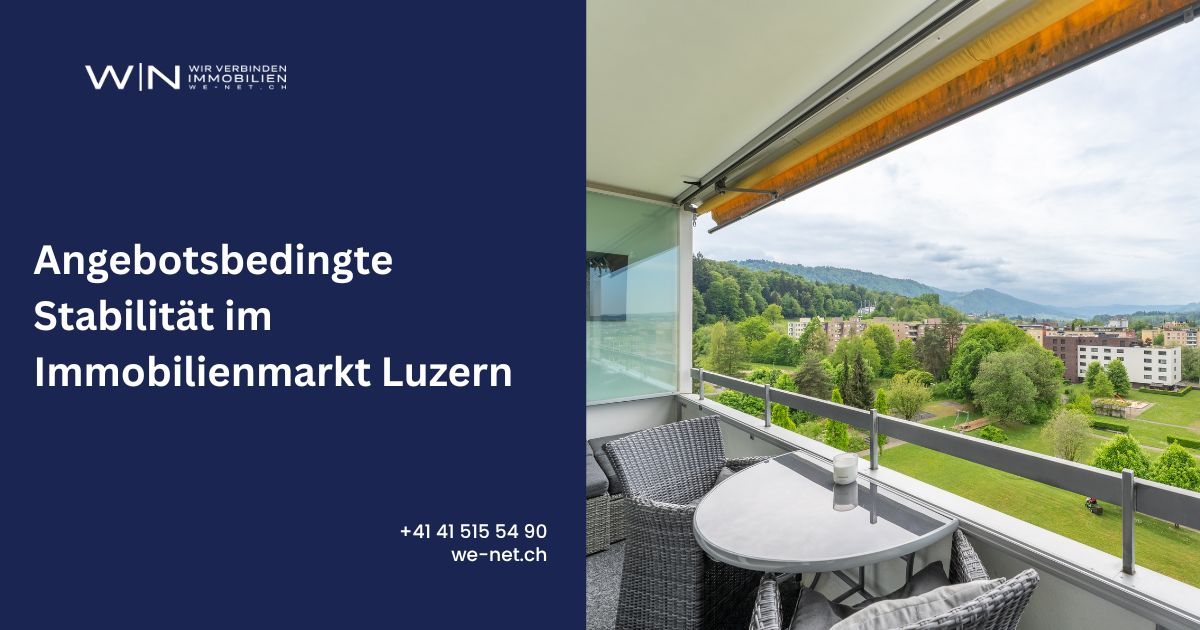
Within this already tight market, the micro-location becomes disproportionately important. Even slight differences in sea view, hillside location, or accessibility can cause significant price variations. Scarcity here is not homogeneous, but highly differentiated.
For investors, this means a clear shift in logic: short-term market movements are no longer decisive, but rather the quality of the specific location.
| Key figure | Value | Period |
|---|---|---|
| Vacancy rate | ~1.0% | 2024/2025 |
| Price trends (Swiss real estate index) | +80% to +110% | approx. 2000–2024 |
| Annual price development | +2% to +5% pa. | long-term average |
| Price level of residential real estate (Central Switzerland region including Lucerne) | CHF 7,500 – 11,000 / m² | current market range |
| New construction activity | below national average (low) | structurally |
| Availability of building land | severely restricted | structurally |
Investment logic and market behavior
The real estate market in Lucerne requires a differentiated approach compared to more dynamic urban centers.
The most important consequence of structural scarcity is that the timing of entry becomes less important. The quality and location of the property are far more crucial. High-quality properties in prime micro-locations exhibit significantly greater value stability than those in average locations.
Furthermore, the micro-location is gaining disproportionate importance. Even small differences in sea view, hillside location, or accessibility can cause significant price differences. This is a direct consequence of the unevenly distributed scarcity within the market.
Liquidity in the premium segment
Liquidity also requires a differentiated approach. High-quality properties in sought-after locations are generally easy to sell, while less attractive locations may have longer marketing periods. This is not an indication of market weakness, but rather a consequence of selective demand within a limited supply.
Positioning in the Swiss real estate market
In a national comparison, the Canton of Lucerne positions itself in the mid- to upper-price segment. It ranks below top markets like Zurich or Zug, but exhibits a distinctly strong structural stability.
This position makes Lucerne particularly relevant for:
- long-term oriented private investors
- Owner-occupiers with a focus on quality of life
- Buyers with a relegation background within Switzerland
The market is less speculative than other regions and more oriented towards real location qualities.
Classification from the perspective of WENET AG
From WENET AG's perspective, Lucerne is a classic example of a Swiss real estate market in which Supply restrictions dominate long-term value development.
Consulting in such markets therefore focuses not on short-term market timing strategies, but on structural analysis:
- Identification of objects within narrow micro-segments
- Assessment of regulatory and zoning framework conditions
- Focus on sustainable location quality instead of short-term profit optimization
- long-term holding and asset strategies
In a market like Lucerne, value is created less through speculative dynamics and more through correct positioning within a permanently limited supply space.
Conclusion
The real estate market in the canton of Lucerne is characterized primarily by a structural shortage of supply. The geographical location on Lake Lucerne, as well as strict Swiss building and zoning regulations, permanently limit development.
This results in a market with stable prices, low volatility, and high long-term value retention. Demand from Switzerland and the attractiveness of the city of Lucerne meet a consistently limited supply.
For investors, this means that the crucial factor is not so much the entry point, but rather the selection of the right location within a structurally tight market.